
How Accurate Is Your Tire Pressure Gauge? And Which Ones Prove It
Last updated: October 13, 2026 · Reading time: 9 min
An accurate tire pressure gauge proves it two ways: a stated accuracy grade (ANSI B40.1 or ASME B40.7) measured against full scale, and independent tests against a reference gauge. The 0.1 PSI on a display is resolution — it says nothing about accuracy. Cheap gauges have failed lab tests by 4–6 PSI.
Accuracy vs Resolution: The Spec Everyone Confuses
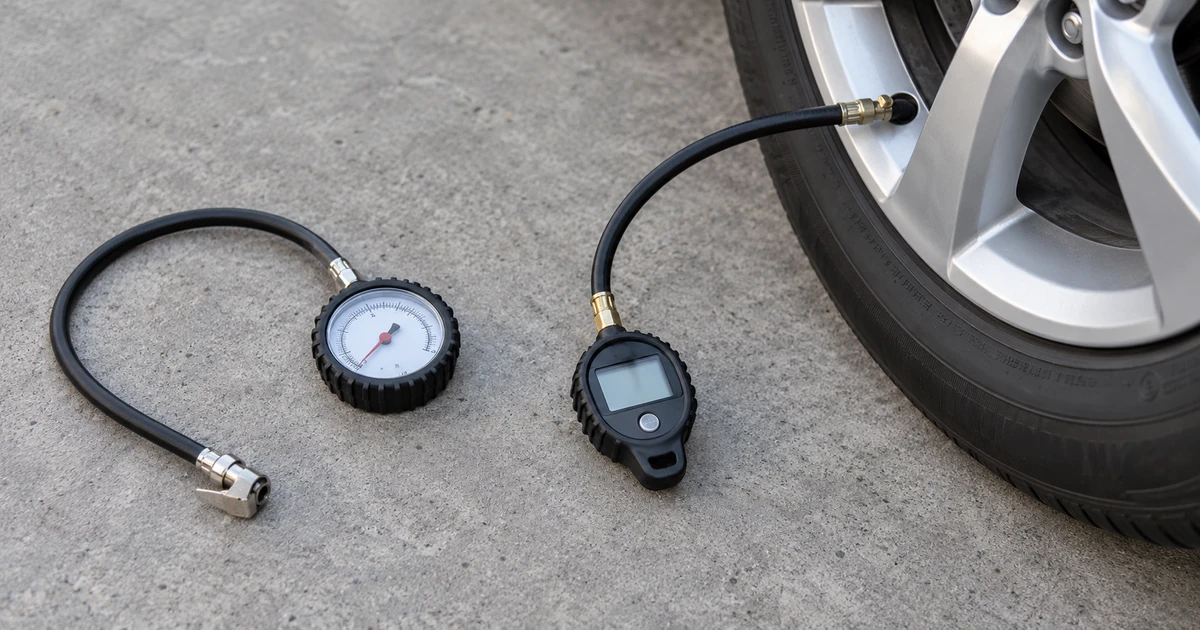
Accuracy is how close the reading is to the true pressure. Resolution is the smallest step the gauge can display. A gauge showing 34.7 PSI has 0.1 resolution — and can still be 2 PSI wrong. JACO (a gauge maker) explains its own specs the same way: resolution of 0.5 PSI means the display steps 1, 1.5, 2, 2.5 — it says nothing about whether 2.0 is the truth.
The second trap is the percentage. WIKA, one of the world's largest pressure-instrument makers, states it plainly: a pressure gauge's accuracy class is expressed in percent of the full-scale value — not in percent of whatever you're measuring. So "±2%" on a 100 PSI gauge means ±2 PSI of possible error at every reading, whether the tire holds 35 PSI or 90 PSI.
| Label claim | Example | Max error | What it means |
|---|---|---|---|
| ±0.5% of full scale | 100 PSI gauge | ±0.5 PSI | Shop-grade (ASME Grade 2A) |
| ±1.5% of full scale | 100 PSI gauge | ±1.5 PSI | Solid consumer grade |
| ±2% of full scale | 100 PSI gauge | ±2 PSI | ANSI Grade B minimum |
| ±1 PSI (flat) | Any range | ±1 PSI | Same at every reading |
| ±1% of reading (rare) | At 35 PSI | ±0.35 PSI | Better — but check the fine print |
Read the spec sheet before the marketing page: look for the words "full scale" (FS) or an explicit "% of reading." If neither appears, assume full scale. Also note that a 150 PSI truck gauge at ±1% FS carries ±1.5 PSI of error — worse absolute accuracy on a car tire than a 60 or 100 PSI gauge with the same percentage. Smaller range, same grade = tighter real-world error.
The Standards Behind the Labels
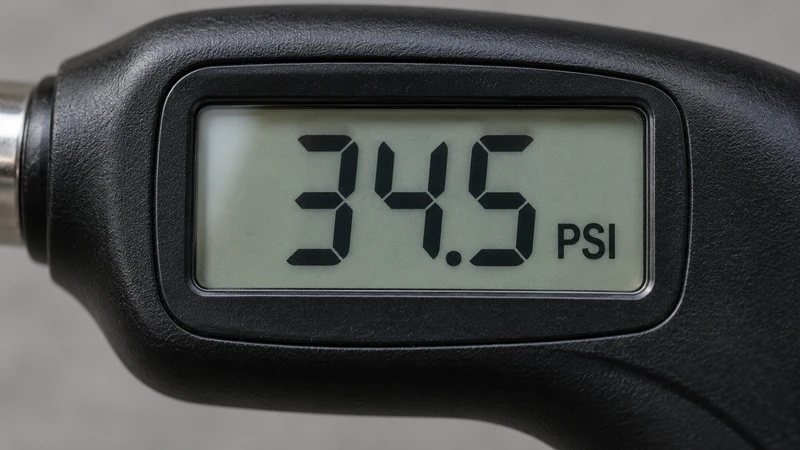
Two certifications actually mean something on a tire gauge. ANSI B40.1 Grade B allows ±3% of span in the first and last thirds of the dial and ±2% in the middle third — the common baseline for decent analog gauges. ASME B40.7 Grade 2A is the digital standard: ±0.5% of full scale, the grade you see on shop-grade handhelds. The full grade ladder is in our gauge roundup and the digital gauge guide; here what matters is the hierarchy: Grade 2A (±0.5% FS) > Grade B (±3-2-3%) > no stated grade at all.
Marketing words that mean less than they sound like: "calibrated" — calibrated against what, and when? Every gauge was compared to something at the factory; the word alone carries no tolerance. "NIST traceable" — real, but narrower than advertised. NIST itself cautions that "traceability alone does not signify or guarantee fitness for purpose": the claim says a comparison chain exists, not that the chain was tight enough for your tires. "Professional" and "heavy duty" — no standard attached at all. The only label claims worth paying for are the ones with a number and a denominator.
Temperature Kills Accuracy Faster Than Age
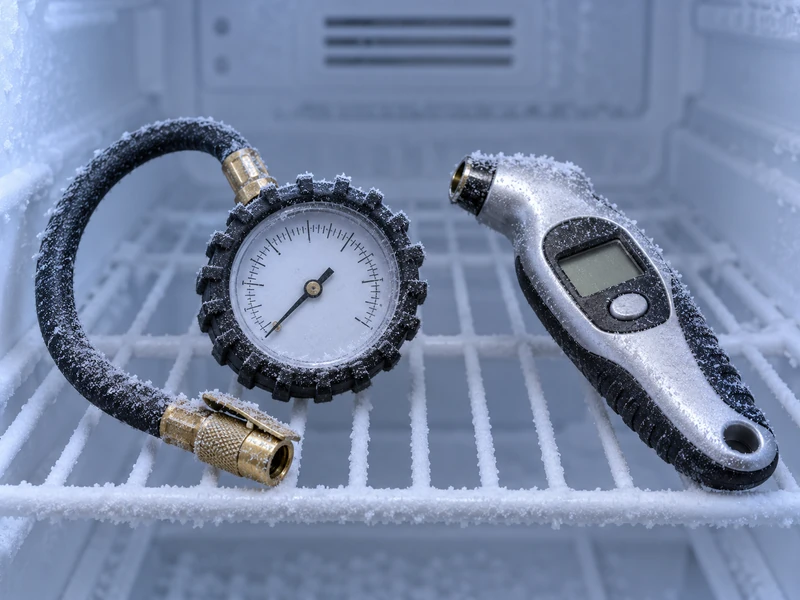
Gauges are specified at room temperature. The international standard for tire pressure gauges (OIML R 23) rates them at 20 ±5 °C and allows an additional ±0.4% of span for every 10 °C outside that band — before any wear or damage. Real life is worse than the standard. Grassroots Motorsports froze four consumer gauges for 18 hours and re-tested them:
| Gauge | Room temp (72°F) | After 18h frozen | Takeaway |
|---|---|---|---|
| $50 dial gauge | −0.9 PSI (2.3%) | −2.0 PSI (5.1%) | Error doubled when frozen |
| $18 digital | +0.4 PSI (1.0%) | No reading at all | Display died in the cold |
| $5 pocket digital | +6.4 PSI (16.1%) | No reading at all | Wrong warm, dead cold |
| $1 pencil gauge | −5.6 PSI (14.2%) | −4.8 PSI (12.4%) | Wildly off at any temperature |
Two lessons. First, a cheap gauge isn't "a little off" — it can be meaningless: the $5 digital was 16% high at room temperature before the freezer even entered the picture. Second, the glove box is the worst place to store a gauge — it swings from below freezing to dashboard-oven heat daily. TechGearLab noted the same pattern from the other side: several digital gauges carry operating limits around 14–122 °F, while a mechanical pencil gauge works at any temperature you'll ever check tires in. If your gauge lives in the car, mechanical or pro-grade digital survives; bargain electronics don't.
Why Your TPMS, Gauge, and Pump All Disagree
Same tire, three devices, three numbers — this is the most common tire-pressure question on the internet, and it usually isn't a broken device. Work the list in order:
- Conditions first. A hot tire reads 4–6 PSI higher than a cold one (see cold vs hot tire pressure). If the TPMS read at 70 mph and the gauge read the next morning, you measured two different pressures, not two wrong devices.
- Technique second. A hissing chuck is air leaving the tire — repeated attempts genuinely lower the pressure, which is why successive readings can drift down. Press straight, firmly, once.
- Then suspect the devices, cheapest first. Gas station inflator gauges get dropped and run over daily — trust them least (more in the gas station guide). TPMS sensors have their own tolerance and some systems round or update slowly. A decent handheld gauge, used cold, is the reference to build around.
How much disagreement is normal? In RV.com's 20-gauge test against a NIST-traceable reference, the spread across retail gauges was mostly within 2 PSI — that's the realistic noise floor when two devices "disagree." If your TPMS says 36 and your gauge says 34 on a cold tire, neither is broken. If they're 5+ PSI apart, one of them is lying, and the gauge is the one you can verify (next section). Whatever you settle on, NHTSA's baseline stands: check monthly, cold, with a gauge — TPMS is a low-pressure alarm, not a measuring instrument.
How to Verify the Gauge You Already Own
- Consistency check (free, 2 minutes). Same tire, cold, three readings in a row. A spread over ~1 PSI means technique or a sticky mechanism. But passing proves repeatability, not accuracy — TechGearLab's Milton pencil was consistently 1 PSI high across 30 readings. Consistent and wrong is a real combination.
- Cross-check against a known-good gauge. Borrow a certified gauge (or a shop's calibrated tester — many tire shops have one), and read the same tire at the same moment. Two independent quality gauges agreeing within 1 PSI is as close to truth as consumer hardware gets.
- Re-verify after drops and winters. Dial gauges run on a thin coiled Bourdon tube that knocks can bend; one long-term user reported a 3 PSI drift after years of use and drops. If it was dropped, frozen, or baked all summer, check it before trusting it.
- Replace, don't calibrate. Lab calibration with a certificate costs more than a certified new gauge. That route exists for industrial instruments (WIKA recommends yearly recalibration for high-class gauges) — for a $25 tire gauge, verification failure means a new gauge.
Gauges With Real Accuracy Evidence
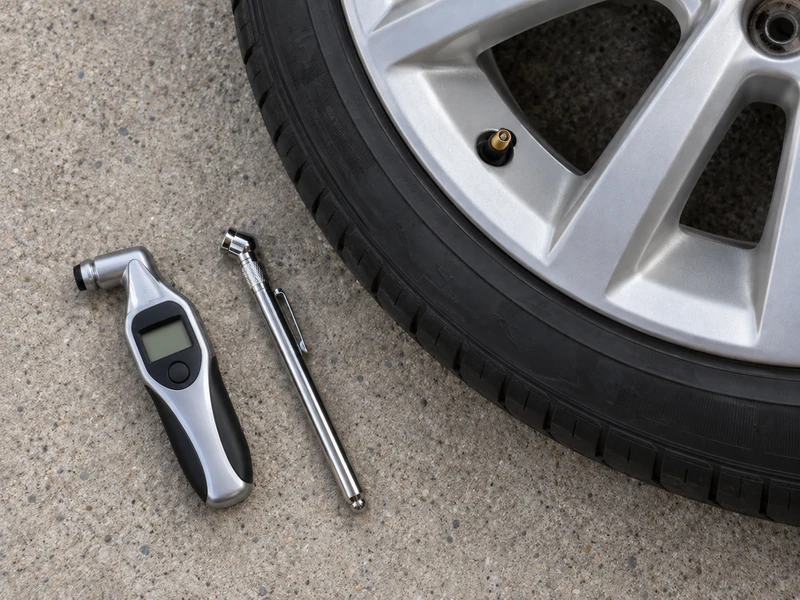
Not rankings — evidence tiers. Each pick below pairs a stated accuracy grade with independent test results (the same picks appear in our full gauge roundup, which scores features and value too). One honesty note: even racing gauges like Intercomp's $400 units claim 0.1% of full scale — perfect accuracy doesn't exist at any price, it just gets narrower.
| Test | Method | Key finding |
|---|---|---|
| TechGearLab (2024) | 8 gauges × 30 readings each at 35 PSI | Milton S-921 consistently ~1 PSI high; Accutire digital most consistent |
| Auto Express (2024) | 8 gauges checked at 20/25/30 PSI | Only 1 of 8 read perfectly at all three pressures; most drifted 0.5–1 PSI |
| RV.com / MotorHome | 20+ gauges vs NIST-traceable reference, 5 set points | Most within 2 PSI; one Slime read 4 PSI high; a $15 Milton was perfect at every point |
Tier 1 — certified grade + repeated independent wins. The JACO ElitePro Digital is rated ASME B40.7 Grade 2A (±0.5% FS = ±0.5 PSI on its 100 PSI scale), took TechGearLab's 30-reading test near the top, and Car and Driver's gear team has used the line daily for years:
JACO ElitePro Digital Tire Pressure Gauge — 100 PSI
approximately $30 · ~4.7 stars · ~6,400+ · PrimePRIME
- •Accuracy: ±0.50% FS (ANSI B40.7 Grade 2A)
- •Range: 5–100 PSI (also bar, kPa, kg/cm²)
- •Resolution: 0.1 PSI on a 2.5" backlit LCD
- •Build: Solid brass and steel, rubber-armored
- •Bleed valve, 10" HybridFlex hose, 360° swivel
- •Locking readout — number stays on screen after removal
- •Battery: 2× AAA (replaceable), 150s auto-off
Pros
- Shop-grade accuracy at a consumer price
- Bleed valve for fine-tuning pressure
- Locking readout — number stays on screen after removal
- Flexible hose reaches awkward valve stems
- Lifetime warranty from a US-based company
Cons
- At ~$30, it is 2–3× the price of budget digitals
- Bulkier than a pencil gauge — won't fit in a small glove box
- 100 PSI max is fine for passenger cars but borderline for trucks
Best for: Drivers who want professional accuracy and long-term durability
As an Amazon Associate we earn from qualifying purchases. Prices and availability are approximate and may vary.
Verified by: Project Farm — #1 out of 23 gauges tested · Car and Driver — "Best Overall" · Road & Track — Top Pick
Tier 1, analog — certified grade, no batteries, no cold failure. The JACO ElitePro Analog carries ANSI B40.1 certification (±1.5% FS) and was a top finisher in Project Farm's 23-gauge accuracy test — the freezer-proof counterpart to the digital:
JACO ElitePro Analog Tire Pressure Gauge — 100 PSI
approximately $23 · ~4.6 stars · ~3,000+ · PrimePRIME
- •Accuracy: ANSI B40.1 certified (±1-2%)
- •Range: 0–100 PSI (also 0–60 PSI model available)
- •Display: 2" glow-in-the-dark dial
- •Build: Solid brass and steel
- •Bleed valve, 10" flexible hose, 360° swivel chuck
- •No batteries — fully mechanical
Pros
- No batteries — always ready, even after months in storage
- Glow-in-the-dark dial for low-light conditions
- Solid brass/steel construction, built to last
- Bleed valve for fine-tuning without removing the gauge
- Flexible hose reaches awkward valve stems
Cons
- Less precise than a quality digital (±1-2% vs. ±0.5%)
- Larger and bulkier than a pencil gauge
- Dial can become inaccurate if dropped hard
Best for: Enthusiasts who prefer mechanical tools with no batteries
As an Amazon Associate we earn from qualifying purchases. Prices and availability are approximate and may vary.
Verified by: Same JACO ElitePro line as Project Farm's #1-rated digital gauge
Tier 2 — known, stable offset. The Milton S-921 pencil measured consistently ~1 PSI high in TechGearLab's test. That sounds like a knock; it's actually useful information. A gauge that is always 1 PSI high tells you the truth every time once you subtract one — and its brass, battery-free build works at any temperature that killed the cheap digitals above:
Milton S-921 Single Chuck Pencil Tire Pressure Gauge
$6–$13 · ~4.6 stars · ~3,000+
- •Type: Pencil (stick) gauge, fully mechanical
- •Range: 5–50 PSI
- •Build: Nickel-plated brass
- •Made in USA since 1943
- •No batteries — works anytime, anywhere
Pros
- Dead reliable — no electronics, no batteries, nothing to fail
- Nickel-plated brass construction, built to last decades
- Made in the USA by a company that has made gauges since 1943
- Fits in any glove box, pocket, or center console
- At $6, buy two and keep one in each car
Cons
- 50 PSI max — fine for passenger cars, not for trucks
- Small markings can be hard to read in dim light
- No bleed valve
- Less precise than a quality digital gauge
Best for: Glove box backup that's always there when you need it
As an Amazon Associate we earn from qualifying purchases. Prices and availability are approximate and may vary.
Verified by: Car and Driver — featured compact/pencil pick · Multiple independent reviewers — top pencil pick
Tier 3 — honest budget spec. The AstroAI states a flat ±1 PSI error and stayed within about 1 PSI of the pack in TechGearLab's repeated readings. Not certified, not lab-grade — but the claim is in plain PSI, and the testing roughly backs it:
AstroAI Digital Tire Pressure Gauge — 150 PSI
approximately $12 · ~4.5 stars · tens of thousands · PrimePRIME
- •Accuracy: ±1 PSI
- •Range: 0–150 PSI (also bar, kPa, kg/cm²)
- •Backlit LCD with lighted nozzle
- •Non-slip rubber grip
- •Battery: AAA or LR44 (replaceable), 30-40s auto-off
Pros
- Excellent value — solid performance under $12
- Backlit display and lighted nozzle for dark conditions
- 150 PSI range covers cars, SUVs, and most trucks
- Four-unit readout (PSI, bar, kPa, kg/cm²)
Cons
- Plastic body is less durable than all-metal gauges
- No ANSI certification listed on all models
- No bleed valve — must remove gauge to adjust
- Not suitable for Presta valves without an adapter
Best for: Budget-conscious drivers who want digital convenience
As an Amazon Associate we earn from qualifying purchases. Prices and availability are approximate and may vary.
Verified by: Multiple review sites consistently cite as best under $15 · High-volume seller with strong real-world feedback
Special Uses: Motorcycles, RVs, Off-Road
Accuracy depends on where in the range you read. ANSI tolerances widen toward the top and bottom thirds of the scale, so pick a range that puts your target pressure in the middle: an RV at 80 PSI on a 100 PSI gauge reads in the weak top third (step up to a 150–160 PSI gauge); an aired-down off-road tire at 15–20 PSI on a 100 PSI gauge sits in the weak bottom third (a 0–60 PSI gauge reads truer). Motorcycles add a fit problem — tight valve clearance favors angled chucks and hoses over stubby pencil bodies. Multi-vehicle households are exactly where two mid-range gauges beat one wide-range gauge.
Key takeaways
- ✓Accuracy is quoted in % of full scale: ±2% on a 100 PSI gauge means ±2 PSI of possible error at any reading — not 2% of your 35 PSI.
- ✓Resolution (the 0.1 PSI display) is not accuracy. Fine digits can still be wrong.
- ✓Temperature kills cheap gauges: in one freezer test a $5 digital read 16% high at room temperature, then died in the cold.
- ✓Verify your gauge: 3 cold readings for consistency, then cross-check against a known-good gauge. Consistency ≠ accuracy.
- ✓Evidence-backed picks: JACO ElitePro Digital (ASME Grade 2A, ±0.5% FS), JACO Analog (ANSI B40.1), Milton S-921 (stable +1 PSI, works frozen), AstroAI (±1 PSI budget).
Frequently Asked Questions
My gauge gives the same reading every time — does that mean it's accurate?
No — that only proves it's consistent. Repeatability (same wrong number every time) and accuracy (the right number) are different things. TechGearLab's test found a Milton pencil gauge that was consistently about 1 PSI high across 30 readings: perfectly repeatable, permanently wrong. Consistency is still useful — once you know a gauge's fixed offset, you can mentally correct for it.
What does ±1% accuracy actually mean on a tire gauge?
Almost always it's percent of full scale, not percent of your reading. On a 100 PSI gauge, ±1% FS means the reading can be off by ±1 PSI whether you're measuring 35 PSI or 90 PSI. JACO's own support docs spell this out: a 100 PSI gauge at ±2% full scale carries ±2 PSI of possible error at every point. Unless the spec explicitly says "% of reading," assume full scale.
Does a 0.1 PSI display mean the gauge is accurate to 0.1 PSI?
No — that's resolution, the smallest step the display can show. A gauge can display 34.7 PSI and still be 2 PSI wrong. Resolution tells you how finely it reads; accuracy tells you how truthfully. Both matter, but only one of them is about being right.
My TPMS, my handheld gauge, and the gas station pump all disagree. Which do I trust?
First rule out measurement conditions: read all three on a cold tire, same morning. TPMS sensors have their own tolerance and some round or lag; gas station inflator gauges take abuse all day and are the least trustworthy of the three. A quality handheld gauge, used cold, is the reference to build your habit around — and if two independent quality gauges agree within 1 PSI, that's your number.
I dropped my gauge. Can I still trust it?
Maybe — verify it before relying on it. Dial gauges use a delicate Bourdon tube mechanism that can drift after a knock; one forum user reported a 3 PSI drift on an Accu-Gage after years of use and drops. Cross-check it against a known-good gauge on the same tire at the same moment. If it's off by more than 2 PSI, replace it — consumer gauges aren't worth lab calibration fees.
How much do I need to spend for an accurate tire pressure gauge?
About $25–$30 buys a certified gauge at ±0.5% of full scale (ASME B40.7 Grade 2A) — shop-grade accuracy. Under $10, a brass pencil gauge is mechanically simple and durable, but budget units have failed independent tests by 4–6 PSI, so verify a cheap gauge against a good one before trusting it. Spending more than ~$30 buys durability and features, not meaningfully more accuracy.
References
- JACO Support — Accuracy vs resolution (±2% full scale on a 100 PSI gauge = ±2 PSI at any reading; 0.5 PSI resolution example)
- WIKA — Pressure gauge FAQ (accuracy class is expressed in percent of full-scale value)
- NIST — Policy on metrological traceability ("traceability alone does not signify or guarantee fitness for purpose")
- OIML R 23 (1975) — Tire pressure gauges for motor vehicles (max permissible errors; ±0.4% of span per 10 °C outside 20 ±5 °C)
- TechGearLab — Best tire gauge test (8 gauges, 30 readings each at 35 PSI; Milton S-921 consistently ~1 PSI high)
- Auto Express — Best tyre pressure gauges 2024 (8 gauges checked at 20/25/30 PSI; only one perfect at all three)
- Grassroots Motorsports — Do ambient temps affect tire pressure gauges? (4 consumer gauges frozen 18 h; errors doubled, digitals died)
- RV.com / MotorHome — Testing tire gauges (20+ retail gauges vs NIST-traceable reference at 30–120 PSI; most within 2 PSI, worst 4 PSI high)
- NHTSA — TireWise tire safety (check pressure monthly with a gauge, including the spare; cold tires)